How to Choose Your First Wild Camping Location in the UK: The Pre-Flight Checklist
As an Amazon Associate I earn from qualifying purchases. This page contains affiliate links — if you buy through them, I earn a small commission at no extra cost to you.
Picking your first wild camping spot in the UK can feel like a minefield. You’ve got the gear sorted – that’s the easy bit – but then you pull up the map and wonder where you can actually pitch without getting into trouble. Here’s the thing: “open access” doesn’t mean you can just throw your tent down anywhere. I’ll walk you through the exact steps I use to find a legal, safe, and truly wild spot, turning that nervous energy into confidence.
First, make sure your kit is sorted – the Essential Wild Camping Gear guide will tell you what you really need, not just the nice‑to‑haves. Then, follow the Pre‑Flight Checklist: legal check, red‑flag audit, visual scout, and the golden rules. By the end you’ll know exactly how to pick a spot that’s legal, low‑risk, and still feels like a proper wilderness night.
What are the legal rules for wild camping in the UK?
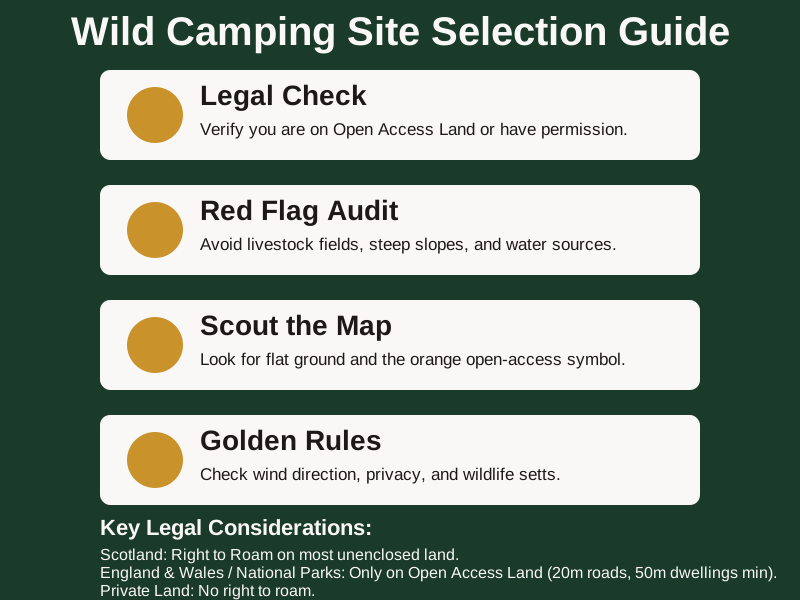
In the UK, the legal rules for wild camping split clearly into two main areas. Scotland offers a broad ‘Right to Roam’ under the Scottish Outdoor Access Code, allowing you to camp on most unenclosed land if you’re responsible. England and Wales, however, are far more restrictive, generally limiting wild camping to specific Open Access Land as defined by the Countryside and Rights of Way Act 2000 (CRoW).
- Scotland – You can camp on most unenclosed land, as long as you’re respectful and stay clear of crops and buildings.
- England & Wales – You’re limited to Open Access Land (mountain, moor, heath, down, and registered common land). On this land you must stay at least 20 m from a road and 50 m from a house or structure (as advised by The Ramblers Association).
| Scotland | England & Wales | |
|---|---|---|
| Legal right to camp | ✔︎ (wide) | ✔︎ (only on Open Access) |
| Need farmer’s permission? | No (unless on private land) | Yes, if not Open Access |
| Typical “no‑go” distance | – | 20 m from roads, 50 m from dwellings |
I once saw a mate set up a tent on a sheep‑run in the Peak District, assuming the open fields were free for all. A landowner spotted him, called the police and the fine was a tidy £200. The lesson? Open access isn’t a free‑for‑all; it’s a specific legal category.
The “Red Flag” Audit: What to Avoid Before You Arrive
Think of the Red Flag Audit as your pre‑flight safety check – you’re looking for anything that could land you in trouble or give you a miserable night.
Here’s what to keep an eye out for:
- Livestock fields – Cows and sheep can carry parasites and may become aggressive if you get too close. Legally, camping within 50 m of grazing livestock is often considered trespassing.
- Steep slopes – A flat, well‑drained site is non‑negotiable. I spent a night on a scree slope in the Lake District because I missed the contour lines; the wind turned my tent into a kite and I woke up with a sore back.
- Water sources – Pitching right on a riverbank looks romantic but attracts midges, erodes banks, and can flood. Aim for at least 50 m away – that’s roughly 65 steps – to protect the environment and keep yourself safe (a good rule of thumb from Natural England’s guidance on river protection).
- Paths & tracks – Setting up on a visible footpath is a magnet for police patrols and other walkers.
If any of these red flags pop up on your map or in the field, move on. The goal is to eliminate risk before you even step off the car.
The Scout: Visual Checks and OS Maps
A good scout never flies blind. Here’s how I turn a paper OS map into a reliable spot‑finder.- Read the contour lines – Wide, spaced‑out lines mean gentle ground. Look for a “U” shape that can hold a tent without a lot of digging. Tight, zig‑zag lines signal a steep slope.
- Spot the Open Access symbol – On a 1:25 000 OS Explorer map, the orange “open access” icon (a stylised hill) marks land you can legally camp on.
- Check footpaths – Dashed lines crossing the access area indicate public rights of way. If a path runs right through your potential site, you’re better off moving a few metres away.
- Phone signal reality check – Assume you’ll have none. Pack a spare power bank, a paper map, and a whistle.
The OS Maps app’s “Spot Height” feature lets you tap a point and see its exact elevation – handy for confirming you’re not on a hidden dip. I once used Spot Height to locate a flat ridge on the Pennine Way that wasn’t obvious from the trail; a quick glance at the map saved me a half‑hour of wandering.
Choosing a wild camping location in the UK starts with confirming you’re on legally designated Open Access Land, then scanning for red‑flag hazards such as livestock, steep ground, water proximity, and visible paths. Use a 1:25 000 OS Explorer map: look for the orange open‑access icon, read contour lines for flatness, and note any footpaths that cross the area. Keep at least 50 m from water and livestock, and stay 20 m from roads in England and Wales. Verify the spot’s elevation with the “Spot Height” tool, and always assume no mobile signal. By ticking these boxes before you set foot on the ground, you turn a risky guess into a legal, safe, and comfortable campsite.
Now that you know what to look for, Download the Free Checklist and run a quick audit on any spot you’re considering.
The “Golden Rules” for the First Timer
Once the legal and hazard checks are clear, these four rules keep your night comfortable and low‑key.
- Wind direction – Pitch the tent with the headboard facing away from the prevailing wind; it reduces condensation and flaps. A simple belt‑and‑brace approach: stake the front corners low and the rear higher.
- Privacy – Scan for nearby houses, farmyard buildings, or marked “No Camping” signs. If you can see a door from your tent, you’re too close.
- Wildlife – Look for setts or burrows. Badgers and foxes are nocturnal; pitching on a sett can cause them to abandon the area and may be illegal under the Badger Act. I once set up a tent a metre from a known badger sett in the Yorkshire Dales; a curious badger trotted past at midnight, and I felt a pang of guilt. Moving the tent 10 m away solved it instantly.
- Sunset & sunrise – Choose a spot that offers a clear western view for sunset and an eastern opening for sunrise. It adds a magical start and finish to your adventure.
When you tick these boxes, you’ve covered the essentials of a safe, low‑impact first night.
Frequently Asked Questions
Can I wild camp in the Lake District?
Yes, but only on Open Access land and at least 20 m from any road. Stay away from houses and don’t set up on cultivated farmland. The Lake District National Park’s website even provides a downloadable map of permissible areas, which is proper handy.
Is it illegal to camp in a farmer’s field?
Generally, yes. Unless you have explicit permission from the landowner, camping in a field counts as trespassing and can lead to a fine. A quick chat with the farmer can turn a “no” into a “yes”, but never assume it’s allowed.
How far away from a river should I camp?
Aim for roughly 50 m (about 65 steps). This protects the riverbank from erosion, keeps you safe from sudden rises in water level, and reduces the number of midges that love stagnant water edges.
Do I need to ask permission to wild camp?
In England and Wales you don’t need formal permission on Open Access land, but it’s polite to ask a farmer if you see them working nearby. In Scotland the Scottish Outdoor Access Code gives you the right to camp without asking, provided you follow the code’s respect‑for‑others and care‑for‑the‑land principles.
What if I see a “No Camping” sign?
Leave immediately. Ignoring the sign is illegal and can result in a fine or even a court summons. It’s a clear indicator that the landowner or the authority wants the area kept free of overnight stays.
Legal & Access Comparison
| Region | Legal Right | Distance from Roads | Distance from Dwellings |
|---|---|---|---|
| Scotland | Right to Roam on most unenclosed land | No specific rule | No specific rule |
| England & Wales | Only on Open Access Land | 20m minimum | 50m minimum |
| Private Land | No right to roam | N/A | N/A |
| National Parks | Restricted to Open Access | 20m minimum | 50m minimum |
Where to Go From Here
You’ve now walked through the full Pre‑Flight Checklist: legal landscape, red‑flag audit, map scouting, and the golden rules. The biggest hurdle – the fear of getting fined or ending up in an unsafe spot – is behind you. All that’s left is to put the plan into action.
If you’re ready to audit your chosen spot with a proven, step‑by‑step tool, Download the Free Checklist. It walks you through each of the points we’ve covered, so you can double‑check on the day and focus on the stars rather than the paperwork. For more tips and tales from the hills, check out the Wild Camping Guides blog.
Enjoy the peace of mind that comes with a well‑chosen site, and remember: the wilderness is yours to explore, as long as you respect the land and the rules. Happy camping!
Related Guides
For a complete overview, see our Complete Guide to UK Wild Camping & Backpacking for Beginners.
Sources & Further Reading
Land access rules differ between England, Wales, Scotland and Northern Ireland. Confirm the local status before you pitch.
📺 Watch: Is Wild Camping Legal? — BlackBeltBarrister
As an Amazon Associate I earn from qualifying purchases. The products linked above are ones I would use or recommend on my own camps.
📺 Watch: Beginner Wild Camping Kit Guide 2026 - Scotland/UK — Wild Camping Adam