How to Plan Your First UK Overnight Wild Camp: Legal & Safety Guide
This page contains affiliate links. As an Amazon Associate we earn from qualifying purchases — this does not affect the price you pay.
The idea of pitching a tent under a blanket of stars in the UK wilderness is brilliant, isn’t it? But for many first-timers, that excitement quickly turns to a knot of anxiety about legalities and landowners. The fear of getting ‘busted’ by a farmer or police officer is a huge blocker, keeping plenty of good rucksacks packed and maps un-ticked.
Many first-timers have faced this: setting up camp on a private field in the Cotswolds, only to hear a tractor rumble up and a farmer shouting. Packing up in ten minutes, heart pounding, is a reminder to check land access before pitching.
This guide will strip away the legal fog, give you a ready‑to‑use permission script, point you to safe first‑time spots, and make sure you’re packed to stay warm, dry and confident. By the end you’ll know exactly how to plan your first overnight wild camp in the UK without breaking any rules – or your spirit.
*(If you’re heading north, check our Wild Camping in Scotland guide for the right‑to‑roam rules up there.) *
Is Wild Camping Legal in England and Wales?
In England and Wales, wild camping isn’t a legal right, nor is it always outright illegal. The truth, as with most things outdoors, sits somewhere in the middle. While you can’t just pitch up anywhere, there are clear ways to do it responsibly and within the law.
The biggest blocker for most first‑timers is the myth that wild camping is either a free‑for‑all or outright illegal. The truth sits somewhere in the middle.
- Right to Roam – The Countryside and Rights of Way Act 2000 (CRoW) gives you the right to walk on designated Open Access Land, but it does not give you the right to pitch a tent. (Ramblers Association)
- Trespass – In England and Wales trespass is a civil matter, not a criminal offence, but landowners can ask you to leave and may seek an injunction if you refuse.
- Open Access Land – Includes mountain, moor, heath, down and common land. This is where the CRoW right to walk applies – it does not include a right to camp. In practice, a low-impact overnight pitch here, well away from livestock, paths and dwellings, is often tolerated, but the landowner can still ask you to move, and the only place in England with a genuine statutory right to camp is the Dartmoor Commons. (Natural England)
- Police involvement – Officers can only intervene if there’s a breach of the peace or a criminal offence (e.g., damage). Most “bust‑ups” are simply landowners asking you to move.
Quick decision tree
- Is it the Dartmoor Commons? → Yes: you have a statutory right to camp on open moorland.
- Is the land marked “Open Access” on the OS map? → It’s a legal grey area: you have a right to be there, but not a guaranteed right to camp – pitch discreetly, well away from houses and livestock, or ask permission if you’re unsure.
- Is it private farmland, woodland, or a designated campsite? → No: seek permission first.
- Do you see a “Wild Camping – Please Respect” sign? → Follow the guidance on the sign.
Learned the hard way: One camper once set their tent on a farmer’s field that wasn’t marked as Open Access. The farmer’s dog barked, the farmer appeared, and they were politely asked to leave. They didn’t argue – packed up, thanked him, and moved a few hundred metres onto a nearby moor, which was still only a tolerated pitch rather than a guaranteed legal right, but a much lower-risk spot.
Stand‑alone answer – In England and Wales, camping isn’t a guaranteed right anywhere outside the Dartmoor Commons. Open Access Land gives you a right to walk, not to camp – a low-impact overnight pitch there is often tolerated in practice, but the safest and only fully legal route is to ask the landowner’s permission before you pitch, or head to Dartmoor.
The Permission Script (How to Ask)
Asking for permission feels like a bit of a faff, but it’s the quickest way to turn a grey area into a green light. Here’s the simple, polite approach that’s worked for me on a dairy farm in the Cotswolds and a sheep‑run in the Lake District.The Golden Rule – Contact the landowner directly – a phone call or email to the person who owns the land, not a neighbour or a passing hiker.
Permission Script (copy‑paste)
Subject: Request to Wild Camp on [Location] – [Date]

Dear [Landowner’s Name],

I’m an experienced hillwalker planning a short overnight walk in the [area] on [date]. I would love to set up a low‑impact bivvy on a patch of open ground on your property, ideally near the [landmark] and away from livestock.

I will:
- Keep the tent to a single spot and leave within 24 hours.
- Pack out all litter, including toilet paper.
- Avoid any damage to fences, crops or wildlife.
- Respect any specific instructions you may have.

If you’re happy with this, could you please confirm by reply? If not, I completely understand and will look for an alternative spot.

Thank you for considering my request.

Best regards,
Harry
[Phone number] | [Email]
What if they say no? Thank them, pack up, and move on. Respect is the key – you’ll never be “busted” if you obey a clear “no”.
One walker sent a similar script to a landowner in the Yorkshire Dales and received a reply within an hour: “Sure, just keep clear of the sheep pen and you’re good to go.” A simple email can turn a potential conflict into a perfect night under the stars.
(Need help finding landowner contacts? We’ve got plenty more advice on the blog for finding those details.)
Choosing Your First Spot (The “Safe” Approach)
{< youtube Axka00EMwFY >} Even with permission, picking the right spot can make or break the experience. Here’s a quick checklist to keep you on the right side of the locals and the law.
- Avoid popular hotspots – places like the Lake District’s popular valleys attract “camp‑on‑the‑grass” crowds and can irritate land managers.
- Look for green “Wild Camping – Please Respect” signs – they usually mark areas where landowners have given informal consent.
- Apply the 20‑minute rule – if you see people within 20 minutes of setting up, consider moving on.
- Red flags (things that usually mean you should look elsewhere):
- Livestock grazing close by
- Crops or fenced fields
- Visible houses or farm buildings within 200 m
- Signage that says “No Camping” or “Private Land”
A good starter area is the remote sections of the North York Moors – open heath, few farms, and plenty of OS‑marked Access Land.
Mid‑article CTA – You now have the full picture – Download the Free Checklist to make sure you’ve covered every box before you head out.
Packing for Safety (The Essentials)
The night will be cold, wet and dark – but with the right kit you’ll stay comfortable and confident. Below is a pared‑down “First‑Time Kit List” that covers the ten essentials for UK wild camping, with a focus on reliability rather than weight‑saving gimmicks.- Navigation – A 1:25,000 OS Explorer map of your area and a compass (GPS phones die fast in fog).
- Shelter – Four‑season tent with a sturdy guylines system; a footprint to protect the ground.
- Sleeping system – Closed‑cell sleeping bag rated to –5 °C and an insulated sleeping pad (self‑inflating works well).
- Lighting – Headlamp with extra AA batteries (don’t rely on a single spare).
- Clothing – Layered system: moisture‑wicking base, fleece mid‑layer, waterproof outer shell; don’t forget a warm hat and gloves.
- Food & water – High‑energy meals (dehydrated porridge, nuts, chocolate) and a 2‑litre water bottle; a lightweight water‑filter if you’ll refill from streams.
- Fire & cooking – Small alcohol stove, windscreen, and a lightweight pot; a fire‑starter (but check fire bans).
- First‑aid – Basic kit plus blister treatment; a whistle for signalling.
- Emergency – Fully charged phone with offline maps, a spare power bank, and a compact emergency blanket.
Lesson learned: On a misty night in the Brecon Beacons, leaving spare batteries in a pack’s outer pocket can mean the headlamp dies after an hour. Campers report fumbling for a lighter in the panic of darkness. The fix is simple: always stash a spare set of batteries in a zip‑lock pocket inside your jacket.
Leave No Trace & Etiquette
Ethics are the backbone of any sustainable wild‑camping culture. The “Golden Circle” principle is simple: Leave no trace, respect others, and protect the environment.
- Pitch on durable ground – Grass or heath, never on fragile flower‑rich slopes or historic sites.
- Pack out everything – Including toilet paper, food wrappers, and even used tea bags. If you can’t fit it in your pack, it stays in the car.
- Noise control – Keep voices low, especially near farms; a quiet camp is less likely to draw a landowner’s ire.
- Fire safety – Use a stove instead of an open flame where bans are in place; if you must light a fire, keep it under 1 m², burn only dead wood, and fully extinguish before leaving.
Campers in the Peak District have reported pitching near wildflower fields, thinking a few steps onto the edge wouldn’t matter – until a fellow camper points out the damage. Moving the tent and re‑pitching on the grass keeps the flowers untouched. That small correction reminds us that even a single footstep can be a big impact.
(For a deeper dive, see our Leave No Trace Principles page.)
Frequently Asked Questions
Is wild camping illegal in the UK?
In England and Wales, wild camping isn’t a legal right anywhere except the Dartmoor Commons – Open Access Land gives you a right to walk, not to camp, though a discreet overnight pitch is often tolerated. Getting express landowner permission is the only way to camp legally elsewhere. Scotland operates differently, where the Scottish Outdoor Access Code grants a legal right to camp responsibly – with the notable exception of the Loch Lomond & Trossachs National Park permit zones.
What if I see a farmer while I’m pitched?
If you encounter a landowner or farmer, introduce yourself calmly, explain you’re wild camping, and politely ask if your pitch is okay. If they ask you to move, thank them for their time and pack up immediately. Respect and courtesy go a long way, and you’ll avoid any potential conflict.
Can I camp in a lay‑by?
Generally no – lay‑bys are usually private land or designated for short stops. Look for official campsites or Open Access spots instead.
Do I need a permit for national parks?
No, you generally don’t need a formal permit for wild camping in most UK National Parks, but this is a common misconception. However, many parks have specific bylaws, designated areas, or seasonal restrictions you must adhere to. Always check the official website of the specific National Park you plan to visit for their most up-to-date guidance before you head out.
What if it rains heavily overnight?
Waterproof your gear, wear a waterproof outer layer, and use a bivvy or tarp under your tent for extra protection. Change into dry clothes as soon as you can to avoid hypothermia.
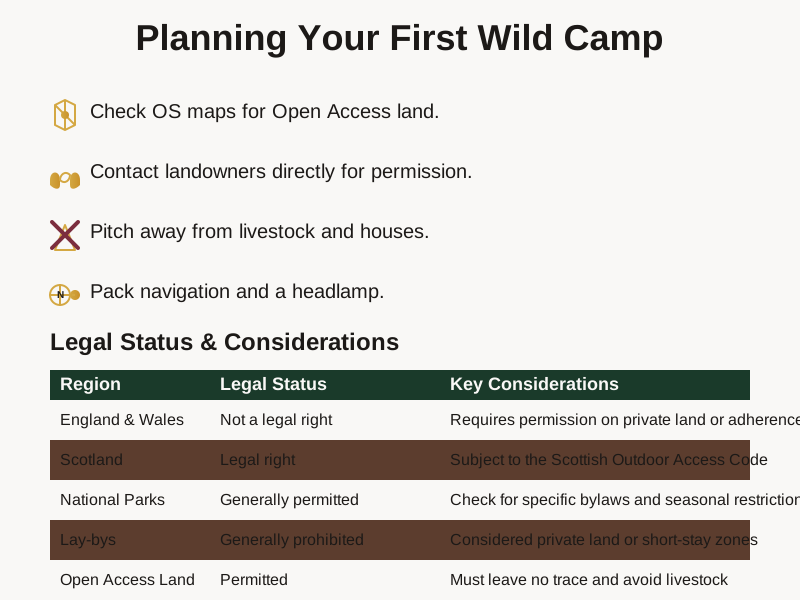
Legal Status of Camping in the UK
| Region | Legal Status | Key Considerations |
|---|---|---|
| England & Wales | Not a legal right | Requires landowner permission; Dartmoor Commons is the one statutory exception |
| Scotland (general) | Legal right | Subject to the Scottish Outdoor Access Code |
| Loch Lomond & Trossachs NP | Restricted, 1 Mar-30 Sep | Camping permit required in designated zones |
| National Parks | Varies by park | Check for specific bylaws and seasonal restrictions |
| Lay-bys | Generally prohibited | Considered private land or short-stay zones |
| Open Access Land (Eng/Wales) | Walking right only | Camping there is tolerated in practice, not guaranteed by law |
Ready to Start?
You now have the legal basics, a ready‑to‑send permission script, a method for spotting safe sites, and a concise packing list that keeps you warm and dry. The remaining step is simply to put it all together and head out.
Remember: ask first, leave no trace, and be prepared for the weather – that’s the recipe for a night you’ll look back on with a grin, not a grimace.
Ready to plan your first wild‑camp adventure? Download the Free Checklist and tick off every essential before you set out.
Good luck, and may the stars be clear and the ground be soft. Safe travels.
Related Guides
For a complete overview, see our Complete Guide to UK Wild Camping & Backpacking for Beginners.
References
Start small. A single night close to home teaches you more about your kit than any guide ever will.
📺 Watch: Is Wild Camping Legal? — BlackBeltBarrister